
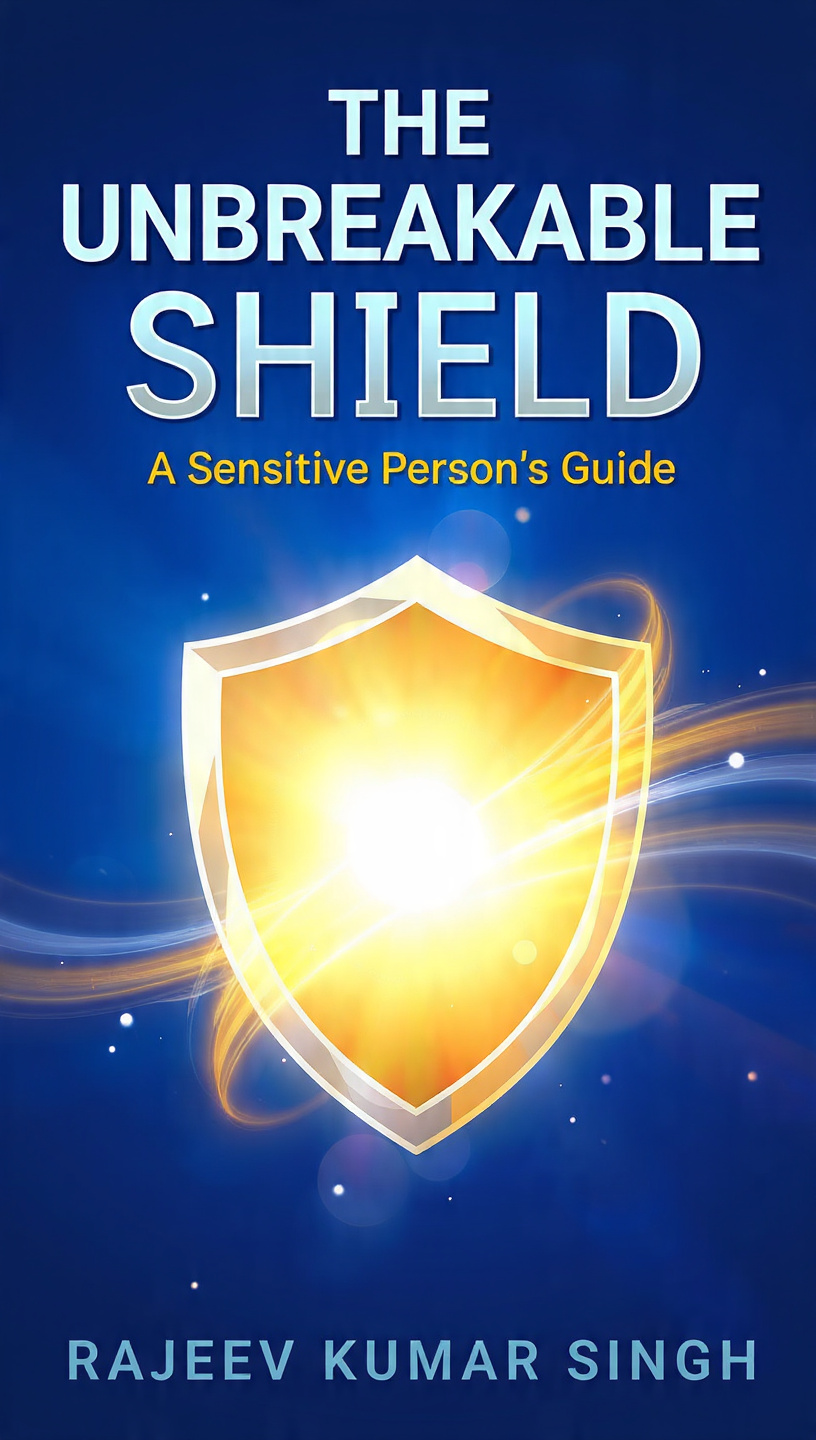
A detailed summary of the book “The Unbreakable Shield: A Sensitive Person’s Guide” by Rajeev Kumar Singh is provided below. The book presents a radical alternative to conventional boundary-setting for highly sensitive people dealing with draining, narcissistic, or self-centered individuals, focusing on energetic sovereignty through disengagement, not confrontation.
The core of the strategy is The Sensitive Person’s Shield—a three-tiered defense framework known as No Reaction, Minimal Communication, and Nominal Relationship (NR-MC-NR). This blueprint helps the sensitive person conserve their energy and prioritize their Natural Self—the core, authentic, regulated, and compassionate self—over the Social Self, which is driven by the need for approval and often acts as a permanent defense mechanism.
Prologue and Introduction: The Core Conflict
The book begins by identifying the high Somatic Cost of being energetically porous. Conventional advice like “say no” or “be assertive” often fails against manipulative individuals, leading to guilt and exhaustion. The anxiety felt around draining people is framed as a physical and energetic byproduct of the conflict between the Social Self (the performer) and the Natural Self (the authentic core).
Draining individuals exploit this conflict by using a Reaction Hook—a comment, criticism, or demand—to pull the Social Self back into a performance and demand Narcissistic Supply (attention, conflict, tears). The goal of The Shield is to dismantle this performance and achieve Cognitive-Somatic Balance (Neurophysiological Regulation).
Part I: The Philosophy of Non-Engagement (No Reaction – Tier 1)
The Three Tiers of Energetic Self-Defense The book emphasizes tailoring the defense to the severity of the relational stress.
| Stress Level | Relational Dynamic | Required Tier of Defense | The Primary Skill |
| Low (Occasional, minor testing) | Distant acquaintance, low-stakes co-worker | Tier 1: No Reaction (NR) | Internal regulation and non-reactivity. |
| Medium (Frequent, passive-aggressive testing) | Acquaintances, extended family, non-critical co-workers | Tier 2: Minimal Communication (MC) | Fact-based, unemotional scripting. |
| High (Constant, chronic supply demand) | Family of origin, embedded dynamics, narcissistic boss | Tier 3: Nominal Relationship (NR-MC-NR) | Automated structure, maximum functional separation. |
Core Practice: The 5-Second Somatic Stop
No Reaction (NR) is the fundamental defense skill and is achieved through somatic intervention, not mental willpower. Its purpose is to teach the toxic person that you are a dead battery, causing them to move on to a juicier source of supply.
The process involves:
- STOP: Freeze the body immediately (no movement, speaking, or eye contact) for 5 seconds.
- SCAN: Rapidly check the body for tension (jaw, gut, shoulders), and name the feeling internally (“Activation. Pressure. Hook.”).
- BREATHE: Initiate a slow, deep 4:6 Breath (4 seconds inhale, 6 seconds exhale) to signal safety to the vagus nerve.
- DELAY: Wait until a discernible drop in internal pressure is felt, which breaks the automatic link between the hook and the reaction.
Neutrality as Vagal Regulation The book stresses that Neutrality is not Apathy; apathy is genuine disconnection, while Neutrality is regulated presence—an active choice to remain calm and centered. Neutrality is a direct function of the Vagal Brake, the body’s mechanism for calming the nervous system. Practices to cue the Vagal Brake include:
- The Soft Gaze: Focusing on the area around the person’s collarbone instead of direct eye contact to avoid triggering an intense threat response.
- Vocal Lowering: Consciously lowering the pitch of the voice to signal calm, authority, and safety to one’s own nervous system.
- The Internal Script: Internally repeating: “This is their story, not my reality,” to create cognitive distance.
Part II: The Practice of Energetic Hygiene (Minimal Communication – Tier 2)
When No Reaction is insufficient, the next tier is Minimal Communication (MC), an external strategy that removes all emotional supply, reducing interaction to a bare, transactional minimum.
The Transactional Mindset The goal is to eliminate JADE (Justifying, Arguing, Defending, and Explaining) from one’s vocabulary. Rules for MC include:
- Be a Broken Record: Repeat the same unemotional, factual statement until the other person gives up (e.g., “I cannot attend”).
- Focus on Logistics Only: Pivot emotional questions to functional topics (e.g., “I’m managing my schedule. Do we still need to confirm the deadline?”).
- Use Time as a Boundary: Always introduce a fixed time limit to the conversation (e.g., “I have exactly four minutes before I need to start my next task”).
Minimal Communication Counter-Script for Gaslighting Gaslighting is a psychological attack designed to make the sensitive person doubt their memory and sanity. The MC counter-script focuses on Fact Over Feeling, acknowledging the gaslighter’s words only as a data point, then returning to one’s regulated truth with short, declarative statements.
Key Counter-Scripts include:
- In response to invalidation (e.g., “You always overreact”): “That is your perspective.”
- In response to denial (e.g., “I never said that”): “I recall it differently,” or “My notes show”.
- To end the discussion: “I disagree with your assessment of my reaction. I have nothing further to add.”
Logistical Separation Minimal Communication must be reinforced by Logistical Separation to minimize spontaneous, draining contact. This includes:
- Creating a Sovereign Space: Designating an area (bedroom, office) as a sanctuary where one is unavailable for non-emergency interaction.
- Scheduled Retreats: Planning regular, non-negotiable breaks from shared environments (e.g., a walk).
- Functional Encounters: Using a brief, logistics-driven script during mandatory interactions (e.g., “Hello. Need anything from the store? Great. See you later.”).
Part III: The Architecture of Sovereignty (Nominal Relationship – Tier 3)
Nominal Relationship (NR) is the highest tier of defense, required for chronically chaotic people who cannot be physically removed (e.g., family, boss). It is the strategic deployment of all three tiers (NR-MC-NR) together to change the relationship from relational to functional.
Defining the Nominal Relationship The relationship operates on two core principles:
- Zero Expectation of Reciprocity: Accepting that the person will never provide the desired emotional fulfillment, which liberates emotional supply by killing the “hope” (the final Reaction Hook).
- Strictly Functional Interaction: All dialogue is restricted to shared logistics (deadlines, schedules, legal issues).
The Architecture of Low Visibility In the NR, one must become boring to the draining person.
- Eliminate the “Why”: Never explain one’s actions; explanations are supply. Use a final fact instead (e.g., “I will not be available for that task.”).
- Embrace Neutral Boredom: Offer the most generic, neutral response to personal questions (e.g., “It was fine,” or “Nothing new”).
- The Unilateral Decision: The new structure is enacted unilaterally through consistent, non-reactive behavior; the draining person’s reaction is their problem.
The Logistical Blueprint: Automating Sovereignty Success depends on automating boundaries to run on structure, not daily willpower. This is achieved through three pillars of functional separation:
- Financial Decoupling: Separating joint accounts, ensuring income flows to a sovereign account, and using functional, non-emotional scripts for all necessary financial transfers.
- Schedule Segmentation: Establishing and communicating non-negotiable “Unavailable Hours” and enforcing strict time limits for necessary meetings.
- Information Control (The Buffer Strategy): Creating an information delay or filter, such as switching non-urgent topics to email-only and immediately redirecting personal questions to a formal, sterile medium. Additionally, one should guard good news from the draining person and handle “Flying Monkeys” (third-party messengers) by immediately redirecting them.
The Post-Sovereignty Recovery Protocol
The final phase focuses on managing the internal void and reinvesting conserved energy.
- Managing the Void and Aftershock: The guilt felt after disengaging is an old, conditioned Reaction Hook. This is reframed as Energetic Stewardship and an active choice of Neurophysiological Regulation. The restlessness from conserved energy is managed by scheduling “Unscheduled Time” to teach the nervous system that safety equals stillness.
- Somatic Discharge Protocol: Techniques are provided to complete the stress cycle and release stored survival energy:
- Shaking/Trembling: Gently shaking hands and limbs to cue the body to release activation.
- Orienting: Naming safe objects in the immediate environment to ground the central nervous system in the present reality of safety.
- Vigorous Completion: Engaging in short bursts of intense activity (sprints, loud sigh/yawn) to metabolize stored fight/flight energy.
Reinvestment: Building the Healthy Connection Circle The ultimate goal is selective connection. A healthy relationship is defined as one that leaves you calmer and more energized than when you started, characterized by reciprocal listening, absence of judgment, and emotional safety. Conserved energy should be intentionally allocated: 50% for personal pursuits/creativity, 30% for the Healthy Connection Circle, and 20% for necessary logistics.
The book concludes by stating that the true transformation is establishing safety as the default state. By stopping the reactions and personal communication, the sensitive person is no longer a participant in the draining person’s chaos, achieving emancipation and reserving their greatest strength—their capacity for deep connection—for fertile ground.




 Jazbaat Help Center
अपने सुझाव, अनुभव और टिप्पणी यहां लिखें-