
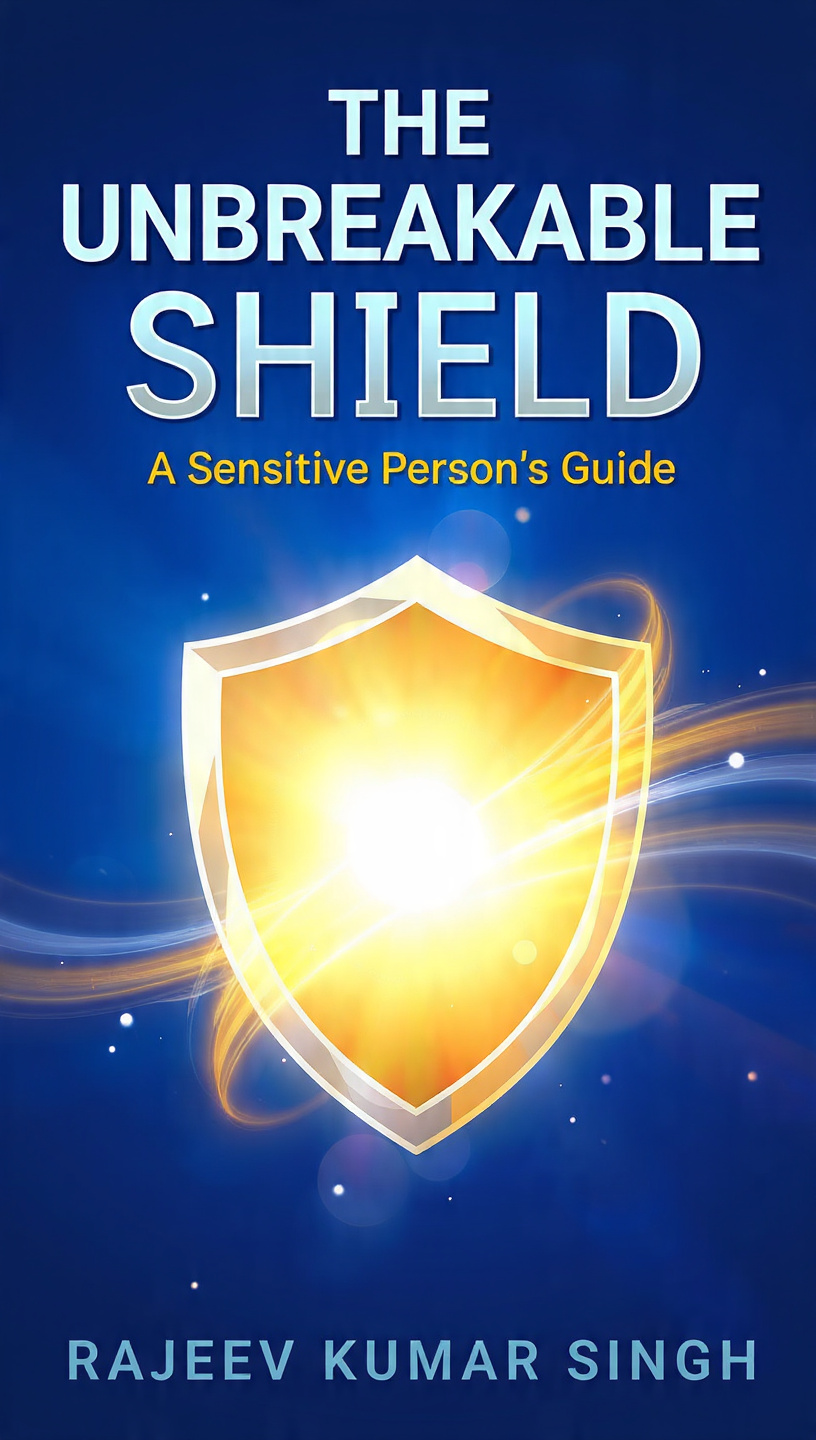
Book Excerpt: The Unbreakable Shield: A Sensitive Person’s Guide
Subtitle: No Reaction, Minimal Communication, and Nominal Relationship (NR-MC-NR)

Prologue: The Cost of Being Highly Available
Introduction: The Social Self vs. The Natural Self
Part I: The Philosophy of Non-Engagement (No Reaction)
Chapter 1: The Three Tiers of Energetic Self-Defense
- The Spectrum of Stress and the Three Tiers
- The Self-Assessment: Calibrating Your Shield
Chapter 2: The Trap of the Reaction Hook and Narcissistic Supply
- Identifying the Somatic Cost of Reactivity
- The Core Practice: The 5-Second Somatic Stop
Chapter 3: Neutrality is Your Superpower, Not Apathy
- Neutrality as Vagal Regulation
- The Practice: Activating the Vagal Brake
Part II: The Practice of Energetic Hygiene (Minimal Communication)
Chapter 4: Minimal Communication: Fact-Based, Emotionless Scripts
- The Transactional Mindset
- Scripting for Minimal Communication
Chapter 5: The Weapon of Gaslighting and the Counter-Script
- Understanding the Gaslighting Loop
- The Minimal Communication Counter-Script: Fact Over Feeling
Chapter 6: The Exit Strategy: Minimizing Exposure and Logistical Separation
- Creating Physical Barriers in Shared Spaces
- The Power of Intentional Distance
Part III: The Architecture of Sovereignty (Nominal Relationship)
Chapter 7: Nominal Relationship: The Final Tier of Disengagement
- Defining the Nominal Relationship
- The Architecture of Low Visibility
Chapter 8: The Logistical Blueprint: Automating Sovereignty
- Phase 1: The Three Pillars of Functional Separation
- Phase 2: The Physical Environment Audit
Chapter 9: The Post-Sovereignty Recovery Protocol: Reinvesting Your Energy
- Phase 1: Managing the Void and the Aftershock
- Phase 2: Reinvestment: Building the Healthy Connection Circle
Epilogue: The Evolved Self
Bibliography and Suggested Reading
Prologue: The Cost of Being Highly Available
For the highly sensitive person, boundaries often feel like a betrayal. If you have ever felt physically ill after a phone call, found your energy instantly depleted when a specific person enters the room, or struggled for days to recover from a casual, critical comment, this book is your intervention.
You are not overly dramatic; you are energetically porous. Your capacity for empathy and deep connection is a profound strength, but when leveraged by draining, self-centered, or narcissistic personalities—whether in your home, family, or office—it becomes a catastrophic liability. You are a finely tuned radio trying to receive signals from a noisy, broken amplifier.
You have likely tried conventional advice: say no, be assertive, express your feelings. But against manipulative individuals, these tactics often fail, resulting only in escalation, guilt, and exhaustion. Asserting yourself becomes yet another chaotic interaction you must recover from.
This book offers a radical alternative: energetic sovereignty through disengagement, not confrontation.
It introduces The Sensitive Person’s Shield—a three-tiered defense strategy: No Reaction, Minimal Communication, and Nominal Relationship (NR-MC-NR). This is not a guide to becoming anti-social; it is a blueprint for becoming selectively social. You will learn to conserve your energy for the people, passions, and purpose that nourish you, while neutralizing the influence of those who consume you.
Your sensitivity is a gift worth defending. It is time to stop playing defense and start building the architecture of your peace.
Introduction: The Social Self vs. The Natural Self
The anxiety you feel around draining people is not a failure of character; it is a physical and energetic byproduct of a fundamental internal conflict: the war between your Social Self and your Natural Self.
The Natural Self is your core, authentic self—regulated, creative, curious, and compassionate. It thrives on genuine connection, honesty, and somatic peace.
The Social Self is the highly-optimized performer created to fit into a judgmental world. It is driven by the need for approval, fear of rejection, and the need to manage others’ perceptions. In toxic dynamics, the Social Self becomes a permanent defense mechanism, holding your breath, clenching your jaw, and anticipating attack.
This constant performance creates Somatic Compromise—the physical tension and chronic sympathetic nervous system activation that generate anxiety (Van der Kolk, 2014). The draining person exploits this compromise; they use the Reaction Hook to pull your Social Self back into the performance, demanding your energetic supply (your anger, your tears, your explanations).
The Sensitive Person’s Shield is the practice of dismantling the Social Self’s performance by engaging the tranquil Natural Self. It requires you to stop trying to change the toxic person’s mind and focus entirely on regulating your own body. The strategy of No Reaction, Minimal Communication, Nominal Relationship is the ultimate practice in Cognitive-Somatic Balance (Neurophysiological Regulation) (Porges, 2011): bringing your mind and body into alignment by choosing peace over performance.



 Jazbaat Help Center
अपने सुझाव, अनुभव और टिप्पणी यहां लिखें-